
 Image 1 of 2
 Image 2 of 2
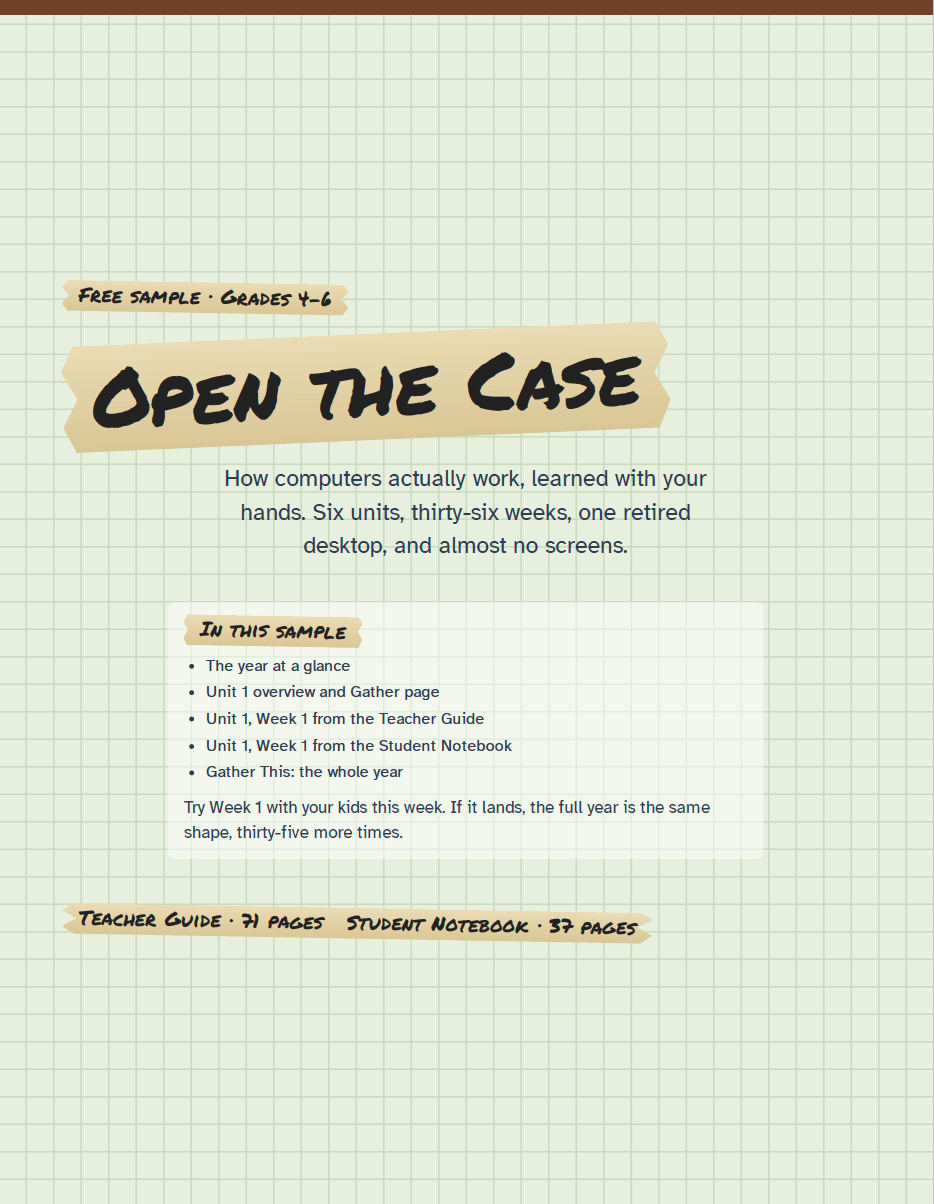
Try Week 1 free before you buy. If it lands, the rest of the year is the same shape, thirty-five more times!
This is not a coding app, and it's not a textbook about computers. It's a year of taking real machines apart at the kitchen table, then putting them back together, until your kid can tell you what every part inside does and why.
Six units, six weeks each, three days a week. Day one is a story and a narration. Day two is a lab: flashlights and Morse code, punched cards and a paper loom, batteries and switches, a retired desktop with the case off, a human internet acted out across the living room, a classmate trained to sort cards like a machine that learns. Day three is the notebook. Every sixth week, the kids teach the parents.
You don't need to know tech to teach this. I've spent 17 years in IT and I also homeschool, so every lesson tells you what to say, what to ask, and what "good" looks like, with a kitchen or a town or a post office standing in for the jargon. If you can read a picture book aloud and hand a kid a screwdriver, you can run this.
Screens show up once all year, for a few minutes, after the kids can already explain what's about to happen. Everything else runs on index cards, tape, a flashlight, one cheap circuit kit, and a dead computer you can usually get for free.
What you get
Teacher Guide, 71 pages: every lesson for all six units, reference charts, the book list, a whole-year gather list, and a glossary in kid definitions
Student Notebook, 37 pages: one page per week, reprintable for every kid in your house
Free updates for life. When something changes, you get the new file.
Family license. Print as many copies as your own kids need. Co-op licenses are available for group classes.
Try Week 1 free before you buy. If it lands, the rest of the year is the same shape, thirty-five more times!
This is not a coding app, and it's not a textbook about computers. It's a year of taking real machines apart at the kitchen table, then putting them back together, until your kid can tell you what every part inside does and why.
Six units, six weeks each, three days a week. Day one is a story and a narration. Day two is a lab: flashlights and Morse code, punched cards and a paper loom, batteries and switches, a retired desktop with the case off, a human internet acted out across the living room, a classmate trained to sort cards like a machine that learns. Day three is the notebook. Every sixth week, the kids teach the parents.
You don't need to know tech to teach this. I've spent 17 years in IT and I also homeschool, so every lesson tells you what to say, what to ask, and what "good" looks like, with a kitchen or a town or a post office standing in for the jargon. If you can read a picture book aloud and hand a kid a screwdriver, you can run this.
Screens show up once all year, for a few minutes, after the kids can already explain what's about to happen. Everything else runs on index cards, tape, a flashlight, one cheap circuit kit, and a dead computer you can usually get for free.
What you get
Teacher Guide, 71 pages: every lesson for all six units, reference charts, the book list, a whole-year gather list, and a glossary in kid definitions
Student Notebook, 37 pages: one page per week, reprintable for every kid in your house
Free updates for life. When something changes, you get the new file.
Family license. Print as many copies as your own kids need. Co-op licenses are available for group classes.